CHARGING TECHNOLOGY
CHARGING TECHNOLOGY
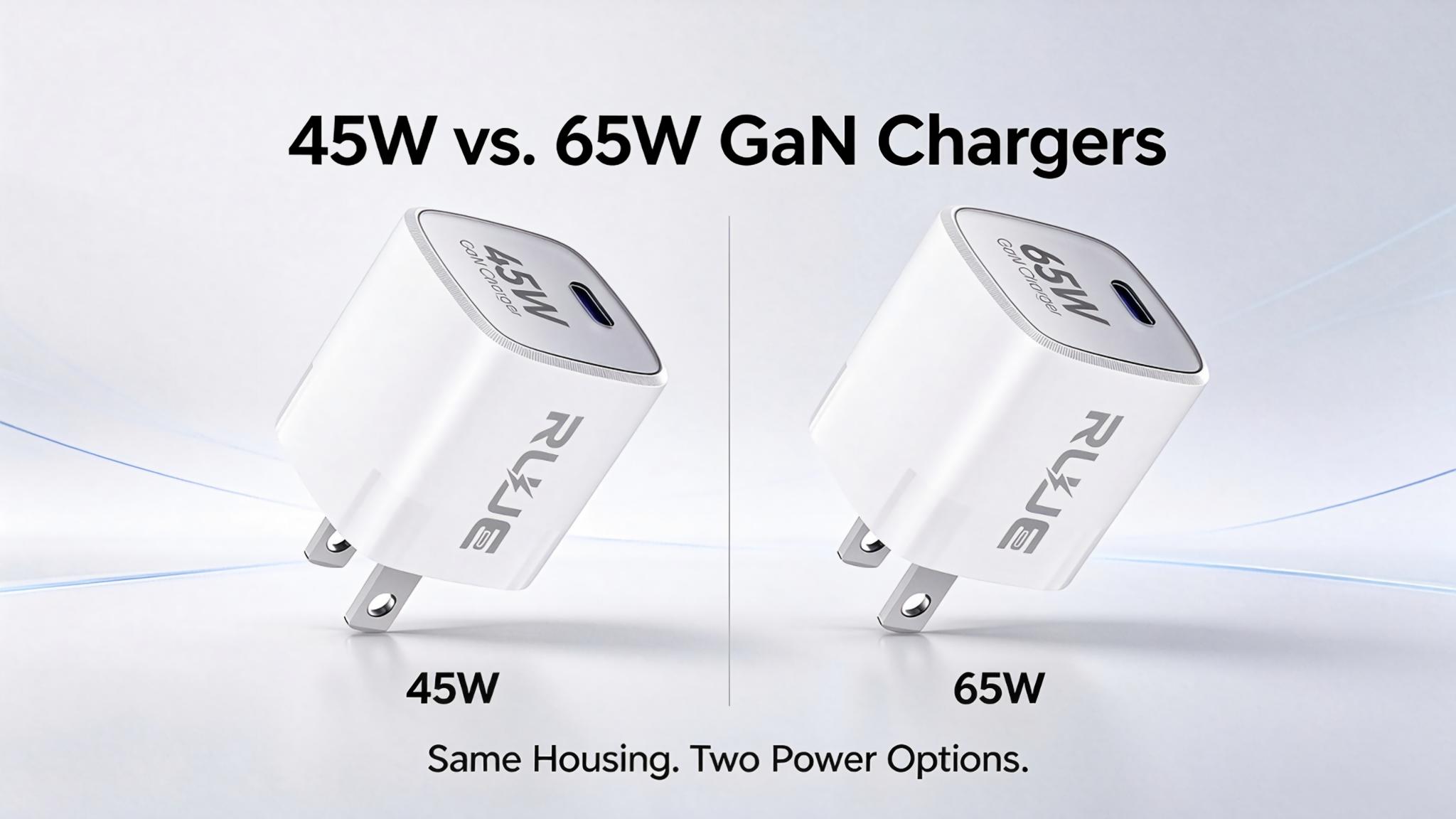
45W vs. 65W GaN Chargers: Which Is Right for Your Market?
Category: Charging Technology / Product Insights
For brands and distributors developing a charging accessory lineup, choosing between a 45W and a 65W GaN charger involves more than comparing power ratings.
Device compatibility, product size, sourcing cost, target users and market positioning all play an important role in selecting the right product.
Our compact GaN charger series, ZH45W1C (45W) and ZH65W1C (65W), offers two power options with exactly the same housing dimensions and tooling. This gives OEM/ODM customers a practical way to build a consistent product family for different consumer needs.
1. Power and Device Compatibility
45W GaN Charger — Everyday Charging
The ZH45W1C delivers a rated output of 45W and supports USB-C PD and PPS fast charging.
It is designed for everyday charging applications, including:
· Smartphones and tablets
· Portable power banks
· Selected low-power USB-C laptops
· Other compatible portable electronic devices
For brands targeting smartphone and tablet users, 45W provides a practical balance between charging capability, compact size and product cost.
Actual charging performance depends on the connected device, supported charging protocols and cable specifications.
65W GaN Charger — More Power for More Devices
The ZH65W1C provides a maximum rated output of 65W (20V/3.25A).
According to its technical specifications, the model supports USB PD 3.2, PPS, AVS and multiple other charging protocols.
Compared with the 45W version, the additional power makes it suitable for a wider range of USB-C devices, including many compatible ultrabooks and business laptops.
For customers who want one compact charger for both mobile devices and laptop charging, the 65W version offers greater flexibility.
The 65W model also incorporates a production-proven NTC-based thermal power management design. It can adjust output power under defined operating conditions to help manage temperature during use.
2. Same Housing, Two Power Options
One of the key advantages of this GaN charger series is its shared housing design.
Both models have exactly the same dimensions:
32.5 × 30.5 × 34.5 mm (excluding plug)
More importantly, the 45W and 65W versions use the same existing housing mold and tooling.
This creates several advantages for OEM/ODM customers:
· Consistent product design: Offer two power options with a unified appearance.
· Reduced tooling investment: No separate housing mold is required when using the existing design.
· Flexible product positioning: Build different power and price tiers within the same product family.
· Simplified product planning: Maintain a consistent visual identity across the charger lineup.
Both models use a PC housing with a specified UL 94 V-0 flammability classification.
For brands seeking a compact and recognizable charging accessory series, a shared housing platform can simplify product development and sourcing decisions.
3. Fast-Charging Protocols and Thermal Management
Charging performance is not determined by wattage alone.
Protocol compatibility also matters, particularly when products are intended for different smartphone brands, tablets and USB-C laptops.
The 65W model's technical specifications include:
The charger also supports additional legacy charging modes.
For brand buyers, the key consideration is whether the charger's supported protocols match the devices commonly used in the target market.
The 65W version features NTC-based thermal power management. Under its designed operating conditions, output power can be reduced to help control heat.
This is particularly relevant for compact, higher-power chargers, where thermal performance is an important part of product evaluation.
4. OEM/ODM Customization and Regional Market Requirements
Beyond electrical performance, brands also need to consider appearance, packaging and regulatory requirements.
The two models are available in standard black and white, with additional color customization options.
The 65W version also offers wine red and sky blue color options, subject to project confirmation.
Plug configurations can be discussed according to the destination market, including US, EU, UK and selected Asian plug standards.
The models have corresponding certification and compliance documentation for their specified configurations, including:
· 45W: CB, CE, FCC, BSMI and CCC
· 65W: CB, CE, FCC, BSMI and KC
Applicable documentation should be checked against the exact product model, plug configuration and destination market before placing an order.
Minimum order quantity: 3,000 pieces per model.
Warranty: 1 year.
For OEM/ODM projects, customization details, order quantities and delivery schedules should be confirmed based on the final requirements.
5. Market Positioning: 45W or 65W?
Although both chargers share the same compact housing, they serve different product positioning strategies.
When 45W Makes More Sense
The 45W model is a strong option for brands focusing on:
· Smartphone and tablet charging accessories
· Mainstream retail and e-commerce product lines
· Cost-conscious consumers
· Mobile accessory bundles
· Compact everyday charging solutions
Its lower unit cost can help brands maintain competitive pricing while offering modern fast-charging capabilities.
When 65W Makes More Sense
The 65W model is better suited to brands targeting:
· USB-C laptop and mobile device users
· Business travelers and mobile professionals
· Higher-power charging accessory lines
· Laptop and mobile charging bundles
· Consumers who value broader device compatibility
The 65W version has a moderately higher unit cost, but its wider charging applications can provide a stronger product proposition for customers who use both laptops and mobile devices.
However, the best choice depends on the intended retail price, device compatibility requirements and target customer group—not simply the highest available wattage.
6. A Practical Comparison for Brand Buyers
7. Which Charger Should Your Brand Choose?
Choose 45W if your main customers use smartphones and tablets, and your product strategy prioritizes everyday charging performance and competitive pricing.
Choose 65W if your customers also use USB-C laptops, and your brand wants to offer broader device compatibility in the same compact form factor.
Alternatively, consider offering both models as part of one product family.
With the same housing design and existing tooling, brands can create a consistent charger lineup while addressing different power requirements and price segments.
The right charging product is not always the one with the highest wattage. It is the one that best fits your customers, target devices and market positioning.
Looking for OEM/ODM GaN Charger Solutions?
We support overseas brands, importers and distributors with charging product selection, customization coordination and order management.
If you are planning a new 45W or 65W GaN charger lineup, feel free to contact us to discuss your target market, product requirements and customization options.
NAVIGATION
Send Us A Message
Please give us a message