OEM/ODM GUIDE
OEM/ODM GUIDE
OEM vs. ODM Car Chargers: Which Solution Is Right for Your Brand?
Choosing the right car charger starts with understanding your customers, not simply comparing specifications.
For brands developing or expanding their car charger product lines, choosing between OEM and ODM is more than a manufacturing decision.
Before selecting a product, it is important to understand your target market, how customers use their devices, your intended retail price, and how the new product fits into your existing lineup.
A conventional 20W car charger is not necessarily limited to the entry-level market, just as a 200W high-power car charger is not automatically a premium product. Power output is only one part of the overall product experience.
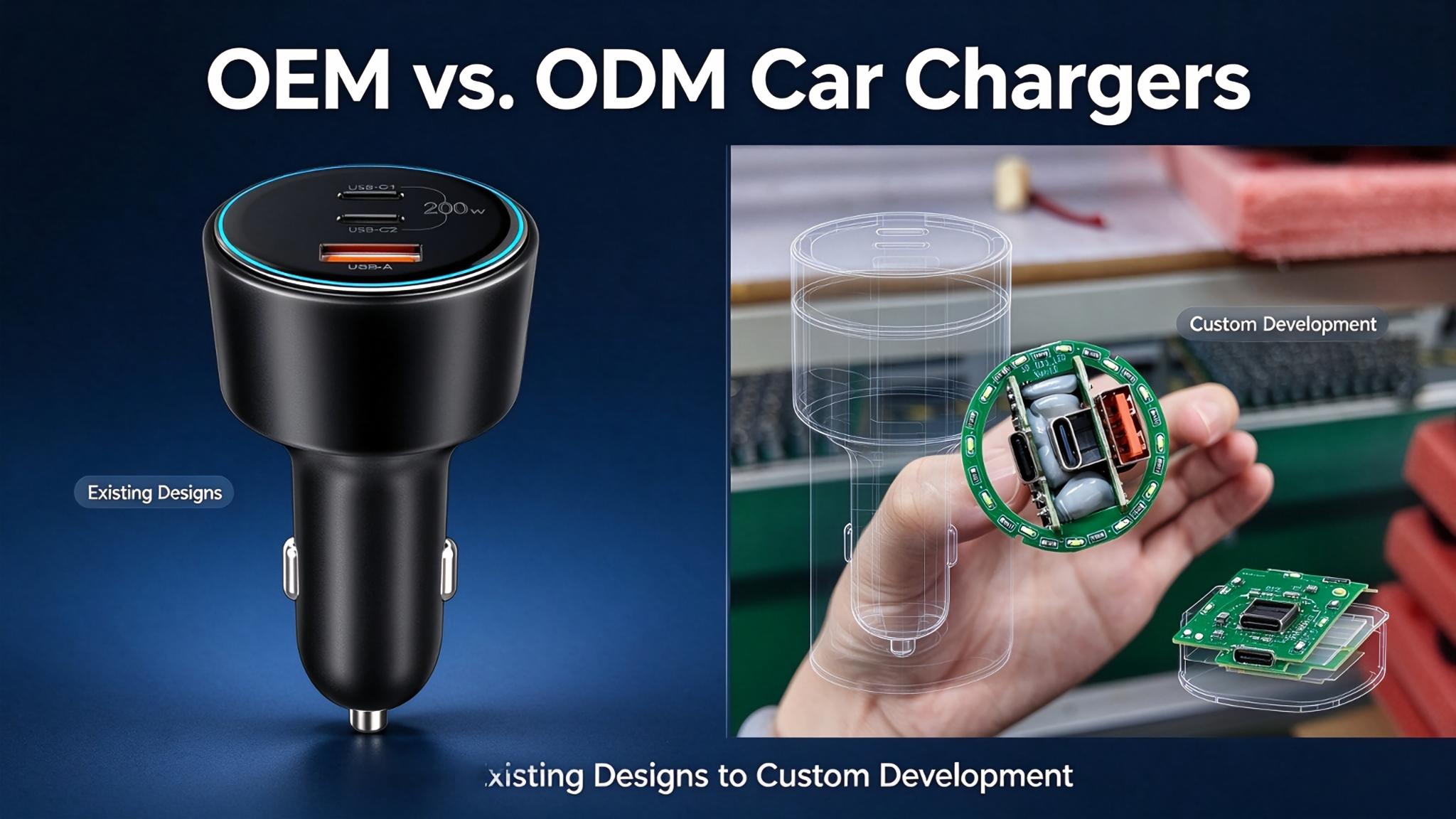
In our cooperation model, we offer two main approaches: OEM private-label manufacturing using existing car charger designs, and ODM custom product development based on customer requirements.
Both approaches can be valuable, depending on your product strategy and business goals.
1. OEM vs. ODM: Understanding the Difference
OEM — Private-Label Manufacturing
With our OEM service, customers can select from our existing, developed car charger models and customize the logo, color, surface finish, packaging, and user manual to match their brand requirements.
Since the product design and core hardware have already been developed, this approach can typically reduce initial development investment and shorten the time required to bring the product to market.
OEM private-label manufacturing is a practical option for brands looking to expand their product range with existing, mature charging solutions.
ODM — Custom Product Development
We provide custom product development services based on customers' specific requirements.
Whether you have a product concept that needs further development or already have your own industrial design and technical specifications, we can support the project with product design, structural engineering, PCB and circuit development, and technical feasibility evaluation.
For example, if you are planning a car charger with retractable cables, multiple USB ports, a unique appearance, or a digital display, we can evaluate the design requirements and work with you to develop a suitable solution.
ODM offers greater flexibility in product development, while engineering feasibility, development costs, testing, and production planning need to be carefully evaluated.
Exclusive sales rights, design ownership, and intellectual property arrangements should be discussed and agreed upon separately.
2. Start With Your Target Market, Not Just the Wattage
One of the most important steps in product planning is understanding who will use the charger and what they actually need.
Higher wattage does not automatically mean a better product. Different users and sales channels may have very different priorities.
Before choosing a car charger, brands should consider:
· Target market: Which countries or regions will the product be sold in?
· Sales channels: Will it be sold through online marketplaces, electronics retailers, telecom operators, or distributors?
· Consumer habits: Are customers mainly charging smartphones, or do they also use tablets, laptops, and multiple devices in the car?
· Usage scenarios: Is the product intended for daily commuting, family travel, business trips, or mobile working?
· Brand positioning: Is the goal to offer an everyday charging solution, a feature-rich product, or a differentiated addition to an existing lineup?
These questions help determine which specifications and product features are truly relevant.
The right product should be built around real customer needs rather than specifications alone.
3. How to Choose the Right Power and Port Configuration
Power output and port configuration are important parts of car charger development, but they should always be evaluated together with actual usage scenarios.
For customers who mainly charge one smartphone, a compact single-port or dual-port charger may be sufficient.
For families or users who frequently charge several devices in the car, multiple USB-C and USB-A ports can offer greater convenience.
For business travelers or mobile professionals who need to charge compatible USB-C laptops, higher-power charging may be an important feature.
However, the total advertised wattage does not necessarily represent the output available from each port during simultaneous charging.
When evaluating a car charger, brands should consider:
· Maximum output power of each port
· Power distribution when multiple ports are used
· Supported fast-charging protocols
· Device and cable compatibility
· Performance under 12V and 24V vehicle input conditions
· Thermal management and long-term operating performance
For example, two multi-port car chargers with the same total wattage may offer very different charging experiences because of their power distribution and port configurations.
Choosing the right specifications is about matching the product to the customer's actual charging needs.
4. Work Backward From Your Target Retail Price
A good product idea also needs a realistic commercial plan.
Before choosing an existing OEM model or starting an ODM project, brands should first evaluate their target retail price and expected selling costs.
These may include logistics, import duties, taxes, distribution or platform fees, marketing expenses, warranty provisions, and the expected profit margin.
Based on these factors, brands can estimate a reasonable target sourcing cost.
For OEM projects, this helps guide the selection of existing models, product configurations, packaging, and customization options.
For ODM projects, the budget may also need to cover product development, tooling, testing, and other project-specific expenses.
The objective is not simply to choose the lowest-cost product.
It is to find the right balance between product performance, customer experience, competitive pricing, and long-term business sustainability.
5. MOQ Depends on the Product and Project Requirements
Minimum order quantity is an important consideration for both OEM and ODM projects.
However, MOQ is not determined simply by whether a project is OEM or ODM.
For OEM projects using existing product designs, MOQ depends on the selected model, components, materials, packaging, and customization requirements.
For ODM projects involving custom development, MOQ needs to be evaluated according to product design, development complexity, tooling requirements, component sourcing, and production feasibility.
Certain customized components or materials may also have their own minimum purchasing quantities.
Therefore, MOQ should be discussed and confirmed on a project-by-project basis rather than treated as a fixed requirement for every OEM or ODM order.
6. Think About Your Product Line, Not Just One Model
A well-planned car charger portfolio should address different customer needs while maintaining a clear brand identity.
For example, a brand may develop a product lineup that includes:
· Compact car chargers for everyday smartphone charging
· Multi-port chargers for families and frequent travelers
· Higher-power USB-C chargers for compatible laptops and mobile devices
· Chargers with retractable cables or digital displays for specific usage scenarios
Not every product requires a completely new design.
Existing OEM models can help brands expand their product range without starting every project from scratch.
ODM development can be considered when existing products cannot meet specific design, structural, functional, or market requirements.
Some brands may also combine both approaches—using existing products for part of their lineup while developing customized models where meaningful differentiation is needed.
The key is to ensure that each product has a clear role within the overall portfolio.
7. Which Solution Should Your Brand Choose?
Consider OEM private-label manufacturing if:
· An existing charger model already meets your product requirements.
· You want to expand your product range without developing new hardware.
· Your priorities include branding, marketing, and distribution.
· You prefer to use an established product design.
Consider ODM custom development if:
· Existing products cannot fully meet your requirements.
· You have specific ideas for product appearance, structure, ports, or functions.
· You already have an industrial design and technical specifications that need engineering development.
· You want to address a particular customer need with a customized product solution.
Neither approach is automatically better.
The right decision depends on your target market, product requirements, available budget, development schedule, and long-term product strategy.
Final Thoughts
Choosing between OEM and ODM should not begin with the question, "Which products does the factory already have?"
A better starting point is:
Who are your customers? What problems are they trying to solve? And how should the product fit into your brand's market strategy?
Once these questions are clear, it becomes easier to determine the right power output, port configuration, product features, target sourcing cost, and development approach.
A good car charger is not necessarily the one with the highest wattage or the most features.
It is the one that delivers the right charging experience for the right customers at the right price.
Looking for OEM or ODM Car Charger Solutions?
We support overseas brands, importers, and distributors with existing car charger solutions and customized product development.
Whether you are expanding your current product range or developing a new design, we welcome the opportunity to discuss your target market, product requirements, and development plans.
Contact us to explore a charging solution that fits your brand.
NAVIGATION
Send Us A Message
Please give us a message