
PRODUCT GUIDE
PRODUCT GUIDE
How to Choose a High-Power Car Charger for Your Product Line
Power output matters, but the right charging experience depends on much more than wattage.
For brands, importers, and distributors developing a car charger product line, choosing the right model is not simply about offering higher wattage.
A charger designed for everyday smartphone use may have very different requirements from one intended for laptop charging, family travel, or commercial vehicles.
Power output, USB port configuration, charging protocols, vehicle input voltage, thermal performance, and target retail price all play a role in product selection.
Understanding these factors can help brands build a more practical and competitive charging accessory portfolio.
1. Understanding Different Power Categories
There is no single wattage that works best for every customer.
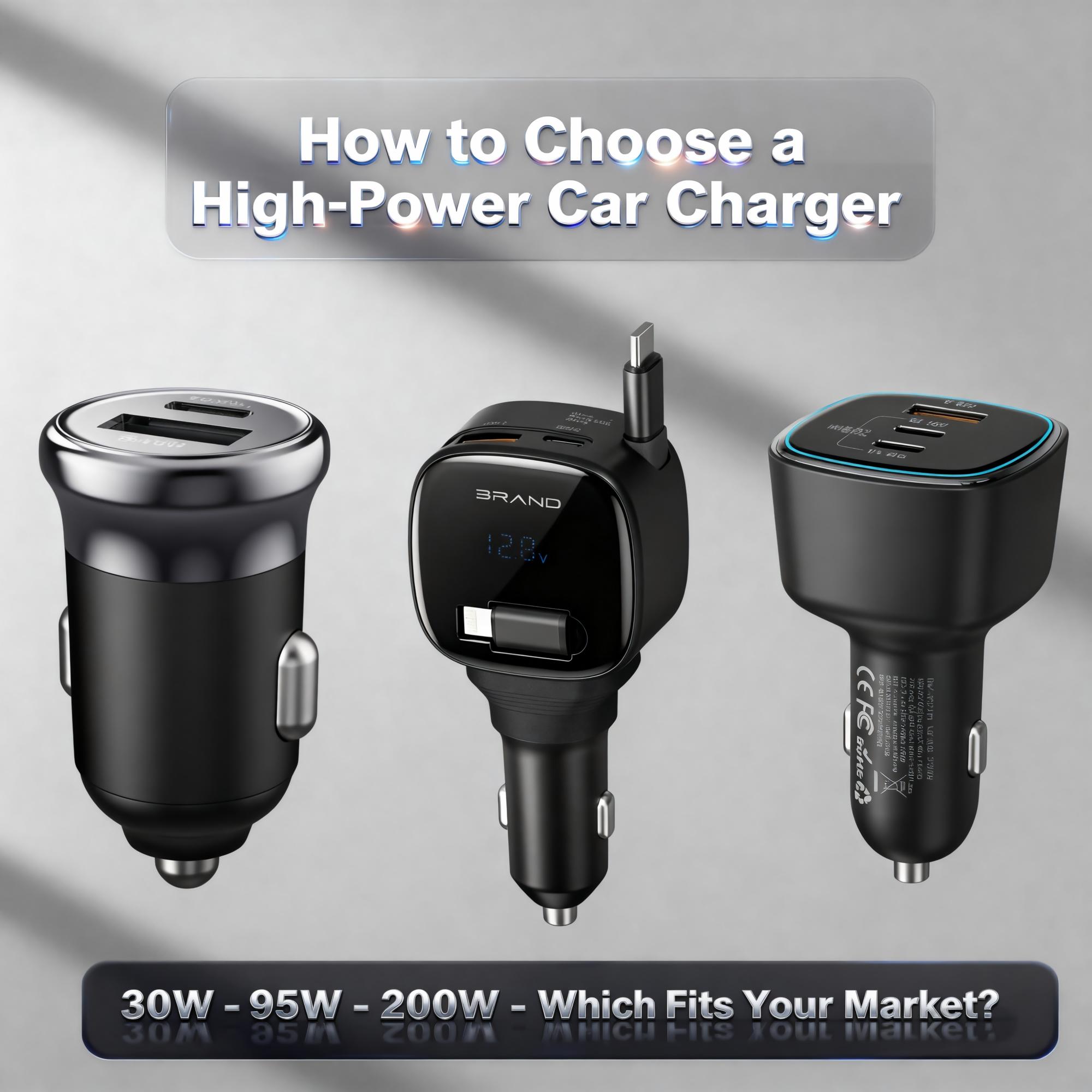
The following examples illustrate how 30W, 95W, and 200W car chargers can serve different usage scenarios. Actual capabilities depend on each product's design and technical specifications.
30W Car Chargers — Everyday Mobile Charging
A 30W car charger can be a practical option for drivers who mainly charge smartphones and other portable devices.
Depending on the model, it may feature a single USB-C port or multiple charging ports.
For multi-port versions, the available output may change when several devices are connected simultaneously.
Potential applications:
· Everyday commuting
· Smartphone and compatible portable device charging
· Retail accessory collections
· Travel kits and promotional bundles
For brand buyers, important considerations include compact design, charging compatibility, product quality, and a retail price that matches the target audience.
A 30W charger does not have to be positioned only as an entry-level product. Its market positioning also depends on design, materials, user experience, and brand strategy.
95W Car Chargers — More Flexibility for Mobile Work
A 95W car charger may appeal to customers who need to charge more than one device while traveling.
Depending on its output configuration, it can support charging scenarios involving smartphones, tablets, and compatible USB-C laptops.
Some models may also include features such as retractable charging cables or multiple USB ports to improve convenience inside the vehicle.
Potential applications:
· Commuting and mobile working
· Laptop and smartphone charging
· Family travel
· Multi-device charging accessories
When selecting a 95W model, buyers should examine the actual output of each port and the power available when multiple ports are used.
The total rated power alone does not tell the full story.
200W Car Chargers — Higher Total Power for Multiple Devices
A 200W car charger is designed for applications requiring higher total charging capacity.
Depending on the model's electrical design, it may support several devices simultaneously, including compatible laptops, tablets, smartphones, and power banks.
Potential applications:
· Multi-device charging during long journeys
· Mobile working and business travel
· Professional users carrying multiple electronic devices
· Selected commercial vehicle applications
However, a 200W rating does not automatically mean the product is suitable for every vehicle or that all ports can deliver their maximum individual output simultaneously.
Buyers should verify the supported input voltage, total and per-port output, charging protocols, and thermal performance.
Higher power can be an important product feature, but premium positioning also depends on product quality, compatibility, design, and user experience.
2. Check Vehicle Input Compatibility: 12V and 24V
Vehicle input compatibility is one of the most important specifications to confirm before choosing a car charger.
Passenger vehicles commonly use 12V electrical systems, while many heavy-duty trucks, buses, and other commercial vehicles use 24V systems.
However, input voltage compatibility is not determined by the charger's output wattage.
A lower-power charger may support both 12V and 24V input, while a higher-power model may have different input limitations.
For brands targeting both passenger and commercial vehicle users, a suitable dual-input design can offer broader application coverage.
Before selecting a model, check:
· Supported DC input voltage range
· Maximum output under different input conditions
· Compatibility with the intended vehicle types
· Relevant protection features and testing requirements
A charger may deliver different maximum output levels under 12V and 24V input. These conditions should be clearly stated in the product specifications.
3. Understand Single-Port Output and Multi-Port Power Distribution
For multi-port car chargers, the total advertised wattage is only the starting point.
Two products with the same total rated power may provide different charging experiences because of their port configurations and power distribution designs.
Buyers should distinguish between:
Single-port output
The maximum power available from an individual port when used alone.
Simultaneous output
The power available to each port when two or more devices are connected.
Power allocation design
How the charger distributes available power among connected devices under different operating conditions.
Some chargers use predefined power-sharing combinations, while others incorporate more flexible power allocation designs.
Neither approach should be evaluated solely by its marketing name. What matters is how the charger performs in real usage scenarios.
For example, a customer charging a laptop and smartphone simultaneously needs to know whether the main USB-C port can continue providing sufficient power for the laptop.
Clear power distribution specifications help brands communicate product capabilities accurately and reduce customer misunderstandings.
4. Evaluate Charging Protocols and Device Compatibility
A higher wattage rating does not guarantee faster charging for every device.
Actual charging speed depends on the charger's supported protocols, the connected device, the cable, and operating conditions.
Depending on the product, relevant protocols may include USB Power Delivery (PD), PPS, and other manufacturer-specific charging standards.
For brand buyers, the priority should be identifying the devices most commonly used by their target customers.
A product intended mainly for smartphone users may have different compatibility requirements from a charger designed for USB-C laptop users.
Protocol support should always be verified against the specific product model rather than assumed from its wattage.
5. Consider Thermal Performance and Product Reliability
As charging power increases, thermal design becomes an important part of product evaluation.
However, thermal performance is not determined by wattage alone. Product size, component selection, circuit efficiency, housing design, and operating conditions also affect temperature.
Depending on the model, thermal management may include temperature monitoring, output adjustment, and other protection measures.
For brands evaluating high-power car chargers, useful considerations include:
· Temperature performance under different loads
· Operation under 12V and 24V input conditions, where supported
· Behavior during extended charging sessions
· Protection and reliability testing
· Consistency between claimed and tested performance
A reliable product should provide an appropriate balance between charging performance, safety, and long-term usability.
6. Work Backward From Your Target Retail Price
Product specifications should support the brand's commercial strategy.
Before selecting a car charger, brands should consider the target retail price, expected customer demand, sales channels, and product positioning.
Logistics, import-related costs, platform or distribution fees, marketing expenses, and after-sales provisions should also be included when estimating a target sourcing cost.
This helps determine which product features create meaningful value for the intended customer.
For example, some customers may prioritize compact size and affordability, while others may value a retractable cable, additional ports, or higher USB-C output.
Adding more features or increasing wattage does not automatically improve sales or profitability.
The right product is the one that offers a compelling balance of functionality, user experience, and price.
7. Build a Product Line Around Customer Needs
Rather than dividing products into entry-level, mid-range, and premium categories based only on wattage, brands can organize their portfolios around different charging scenarios.
A well-planned product portfolio does not necessarily need every available wattage level.
Each model should address a clear customer need and complement the rest of the product range.
Final Thoughts
Before choosing between a 30W, 95W, or 200W car charger, brands should first answer four questions:
1. Who are the target customers, and which devices do they charge?
2. What vehicle input conditions must the charger support?
3. How much power is required from each port during actual use?
4. What product features and sourcing costs fit the intended retail positioning?
Once these questions are clear, it becomes easier to select the appropriate wattage, port configuration, charging protocols, and product design.
The best car charger is not necessarily the one with the highest wattage. It is the one that delivers the right charging experience for the target customer.
Looking for OEM/ODM Car Charger Solutions?
We support overseas brands, importers, and distributors with car charger product selection and customized development solutions.
Whether you are expanding an existing accessory lineup or planning a new charging product, we welcome the opportunity to discuss your target market, device requirements, and product strategy.
Contact us to explore the right car charger solution for your product line.
NAVIGATION
Send Us A Message
Please give us a message